Exhibition Essay
An American Son: A Poetic Symbolic Account of a Life in America
by Angela N Carroll
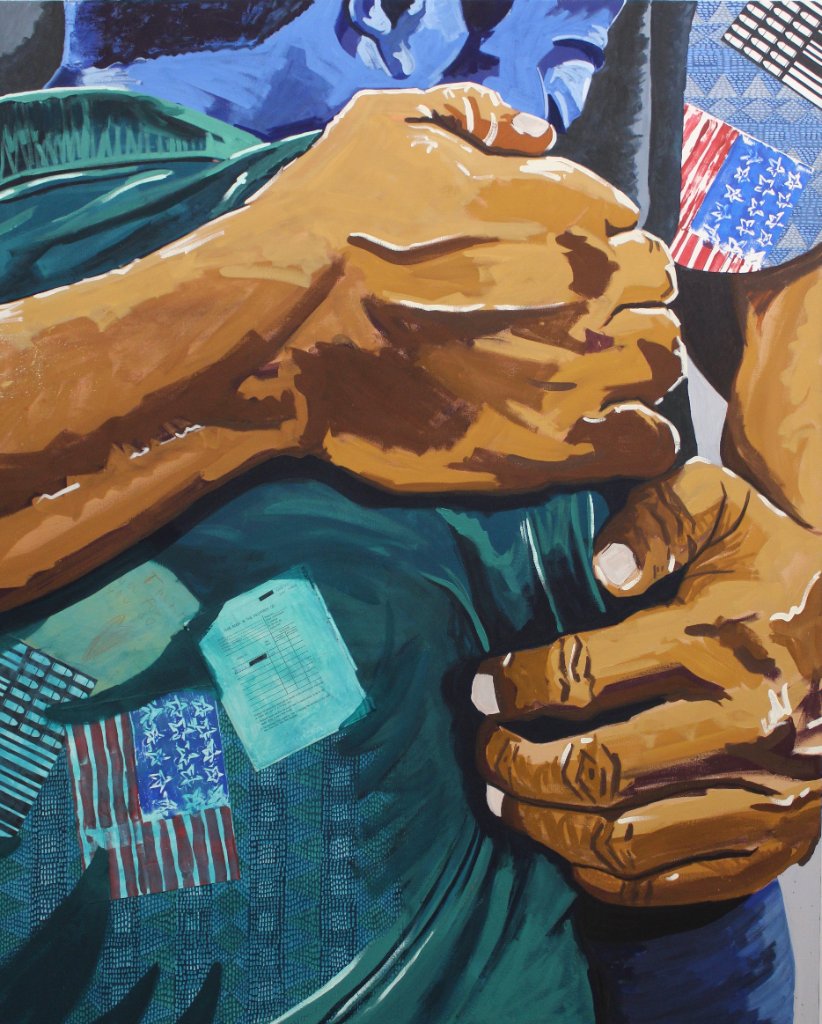
I'm working on it (Wear Your Heart Out), 2025. Casein, Collage, and Monoprint on Canvas.
here on this bridge between starshine and clay,
my one hand holding tight
my other hand; come celebrate
with me that everyday
something has tried to kill me
and has failed
—Lucille Clifton
we owe it to ourselves
to live beyond resilience
—anaiis
The myth of America is upheld by a nation of immigrants. Our collective radical hope for democracy remains an unyielding aspiration for all who seek sustainable futures unstained by the unlearned lessons of previous generations. It is radical imagination and critical re-memory that unmasks civil injustice and holds accountable those who attempt to corrupt the protections guaranteed by the Constitution. Every brave generation that defiantly refuses a life of grim survival, hereafter, catalyzes the realization of new possibilities.
You carry your history with you everywhere you go. The paintings in the An American Son series offer subtle snapshots of Oscar Eduardo de Paz's adolescence, growing up on the north side of Chicago in the communities of Montrose and Ashland. His narrative is told in six chapters: Chapter 1: Survival and Resilience, Chapter 2: Disruption and Dislocation, Chapter 3: Finding Agency, Chapter 4: Acts of Repair, Chapter 5: Self-Discovery and Emergence, Chapter 6: Stepping into Purpose.
Each work reveals the realities of life for many of America's sons. We are all told that if we work hard enough, pull ourselves up by our bootstraps, and take initiative, the achievement of the American dream, the spoils of capital and comfort, will be attained. And yet, many of America's highest-earning cities have soaring rates of homelessness, food insecurity, and strained social services. What does this reveal about the failures of capitalism and our collective consent to accept struggle as the reality of American life?
As a second-generation immigrant, a brown boy descendant of proud Guatemalans, de Paz was not expected to survive his circumstances. Forced to drop out of high school as a teenager, he couch-surfed for years. While trying to grasp his own place in the world, he grew more determined to study the mechanisms of society. What structures sustain rather than resolve poverty? How does over-policing deregulate the emotional well-being of young Latino and African American men? How does fear affect one's ability to live unabashedly free in the world? These are the queries that inform de Paz's practice.
Years later, driven by a refusal to be denied the right to dream, de Paz received his GED and completed his undergraduate studies. In 2016, he entered a PhD program in Public Policy and Administration at the University of Delaware. It was here, while focusing on environmental justice, that he grasped the vast and insidious nature of systems of oppression. What he learned described the frameworks that he, and many other Americans, rarely have the language to articulate, but are required to navigate for their survival. WEB DuBois' postulations regarding double consciousness were especially inspiring. It was one of the first times de Paz read a personal account of the psychological impacts of systemic oppression, a feeling of being split between oneself and others' presumptions. Though the program was enlightening, he was disenchanted by policy work's dislocation from the immediate needs of the community and disturbed by the politics of expected casualties, which were accepted rather than replaced by resolutions to protect poor Americans from harm.
Throughout his life, drawing and writing had always been cathartic practices, but he wondered how narrative could be used to support a radical shift in consciousness towards empathy for those willing to bear witness. He recalled the ways reading comic books and mastering graffiti with his friends as a teenager had been useful ways for them to combat the heaviness of over-policing, racial profiling, and surveillance. The work was communal, young men declaring themselves un-erasable by spraying tags on concrete walls. Everyone, Latino, Asian, and Black, was in the same boat. Some were first-generation Americans, while others, though born in America, were still ostracized by the absurdity of racialized caste. By gleaning lessons from those early experiences, de Paz realized that the work he hoped to do, the earnest work of helping others help themselves know that they are not alone, might best be activated through art.
Fascinated by social realism and gestural mark making, the artist utilizes accessible tools: markers, and paint brushes, to quickly render relatable representations. Conscious and astute about the work of interpretation, de Paz poetically employs relatable symbols in his paintings—dashes, dots, detailed hands, or full portraits—all composed with swift, intentional strokes that are layered and collaged in meticulously generative ways. The rhythmic placement of these forms and figures extends these symbols and gestures, and all confidently reveal the artist's story. By doing so, the work engages viewers in a timely discourse on social structures, cultural constructs, and how environments intergenerationally shape human behavior. It makes sense, then, that de Paz considers the work to be memory composites rather than self-portraits, though many of the scenes he portrays are drawn from his memory. The protagonists and motifs that repeat in his milieus attempt to articulate the power of empathy and human connection that he sought but could not activate in academia.
This push and pull between academic and intrinsic knowledge, theory and lived experience, enunciates itself as a transdisciplinary practice. De Paz instigates decolonial vernaculars that elevate his linguistic and visual artistry. As collaged interventions, fragmented like memory often is, and cinematic in their composition, the artist centers the viewer's gaze as a witness to sharp close-ups of intimate moments. In one panel, his grandmother's strong hands overwhelm the frame with warmth. In another, the safe space of a father's arms becomes an enveloping universe around a young boy nestled in his chest. In the next, giant paint-stained fingers grip spray tips with taut reverence. One and all, de Paz's portraits elevate radical care as a profound persistence of refusal to succumb to struggle.
Rather than situating struggle as the predominant reference for his experience, de Paz exalts un-extraordinary moments of joy, play, and peace as worthy of portrayal. For him, the mundane moments of those who have endured what the artist has termed "systemic suffering" are the most miraculous. He, too, is a walking miracle. His path was a serendipitous path. He figured it out along the way as we all must. These paintings are in some ways the origin of his storied journey from the vulnerable boy he was to the caring man he became. Perhaps the familiarity of his everyday trials and triumphs, meandered by all those traversing broken systems, solidifies this work as quintessentially American.
Guatemala, the land of his ancestry, is another cultural thread that winds through the An American Son series. de Paz depicts symbolic references likened to the flags of Guatemala and America as poignant abstractions, tethered to the dreams his grandmother carried with her as she became an American citizen. Her hopeful vision for a better future for her descendants is his inheritance. Many of his paintings honor her sacrifice by creating vibrant ideograms that recall the iconography of indigenous patterns woven into Guatemalan textiles. These motifs recur iteratively as patches on clothing and book bags, as tags bust across brick walls, or as glyphic geometries scribbled on the worn pages of notebooks. Each glyph a prescient reminder that the strife they carry with them could not deter their hopes for a life free of struggle.
Being good citizens did not protect them from systemic oppression. Being patriotic did not protect them from poverty. His grandmother's dreams of America were met with bitter bigotry. Her grandson's dreams for dignity were met with surveillance and police brutality. De Paz considers the ways these aggressions shape identity, culture, and masculinity. By raising awareness of how fear shapes the formation of identity among young men. His paintings portray safe spaces to reconcile the impact of those traumas and disappointments. This clarifies the impetus to depict young boys clinging to book bags in a prolific manner. We are reminded that these images are the real experiences of many American sons, who every day carry faith and heartbreak, grief and exquisite joy, on their backs. De Paz's paintings are a restorative prayer, a hopeful extension of protection and courage despite all that they have suffered. He documents the radical optimism and dignity that persist against disillusionment. Radical joy to celebrate the structures you've learned to overcome. Radical bravery to learn, adapt, and reshape oneself into a life you want, and into an agency that nothing can deny.
The bravery of his work—subtle victories, humble joy, strong hands, lives depicted earnestly in spite of the crisis of destabilized social services, affirmatively resist the violent dehumanization of Latino experience in America. The power of the work lies in elevating those who refuse to be broken by broken systems. Those who defiantly created their own systems of value and, against all odds, persevered.